The Ocean Is Hiding Creatures We’ve Never Seen
Have you ever think, that Ocean is 80% unexplored. Which type of unidentified sea creature live under water.
Whenever we talk about the unknown, most people look up at the sky and think about space. But I think the real mystery is much closer to us — beneath the waves. The ocean covers most of our planet, yet we’ve barely explored it. That thought alone makes the sea feel endless and slightly unsettling.
Only about 0.001% of the deep ocean (depths > 200m) has been directly observed by humans.
That means in deep ocean, there are some Mythical sea creature, can be living and waiting to be explored by humans
While 27.3% of the seafloor has been mapped via sonar, most of the deep ocean remains unvisited.
1. Angler Fish
A rare live deep-sea anglerfish (Melanocetus johnsonii) was filmed in broad daylight near the surface off the coast of Tenerife, Canary Islands, around January 26, 2025, by Condrik Tenerife. This unusual sighting occurred in shallow, sunlit water, rather than their typical dark habitat 200-2,000 meters deep.
The fish, nicknamed the “Icarus of the deep,” was likely sick or injured, as it appeared to be struggling before dying shortly after.
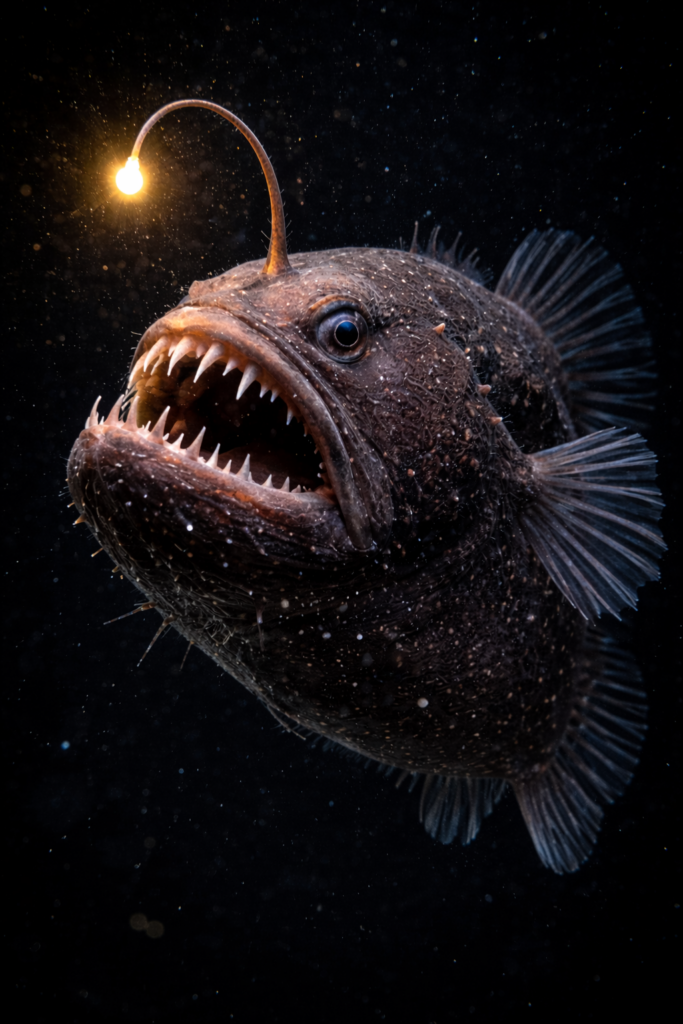
Anglerfish meet to mate in the deep sea, generally at depths of 650 to 6,500 feet (200 to 2,000 meters) or more, where it is pitch black.
The first specimen of the deep-sea humpback anglerfish (Melanocetus johnsonii) was discovered on December 24, 1863, near Madeira, an archipelago off the coast of northwestern Africa.
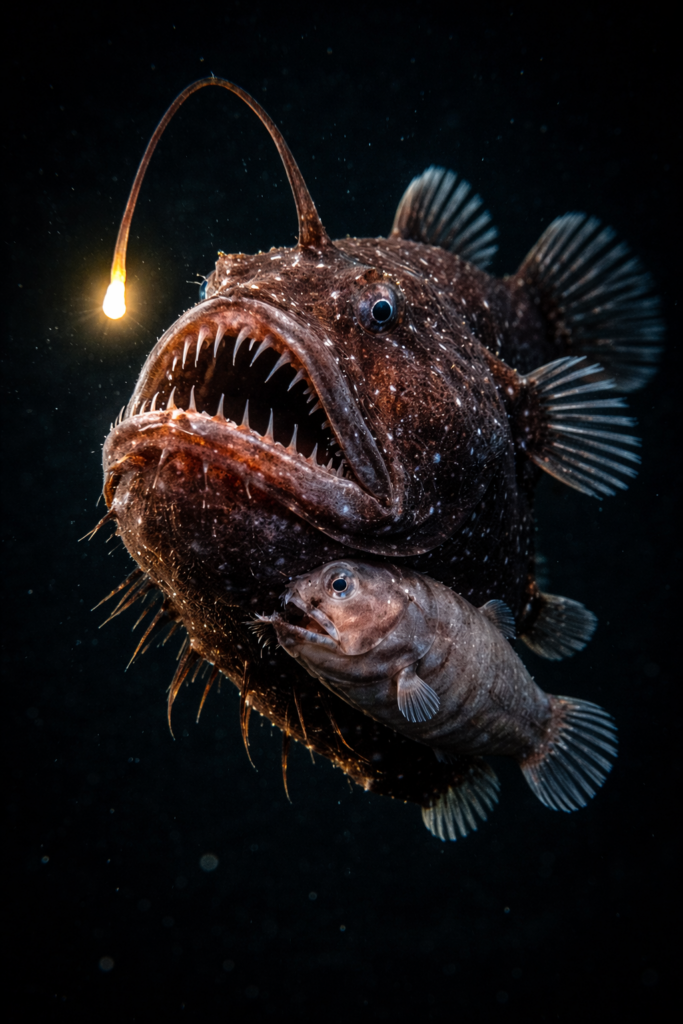
Unique Trait:
Females are much larger than males. In some species, the male permanently attaches to the female and becomes part of her body.
2. Vampire Squid
Despite its frightening name and appearance, the vampire squid (Vampyroteuthis infernalis, meaning “vampire squid from hell”) is not a blood-drinking monster. It is a unique deep-sea animal specially adapted to survive in one of the most extreme environments on Earth.
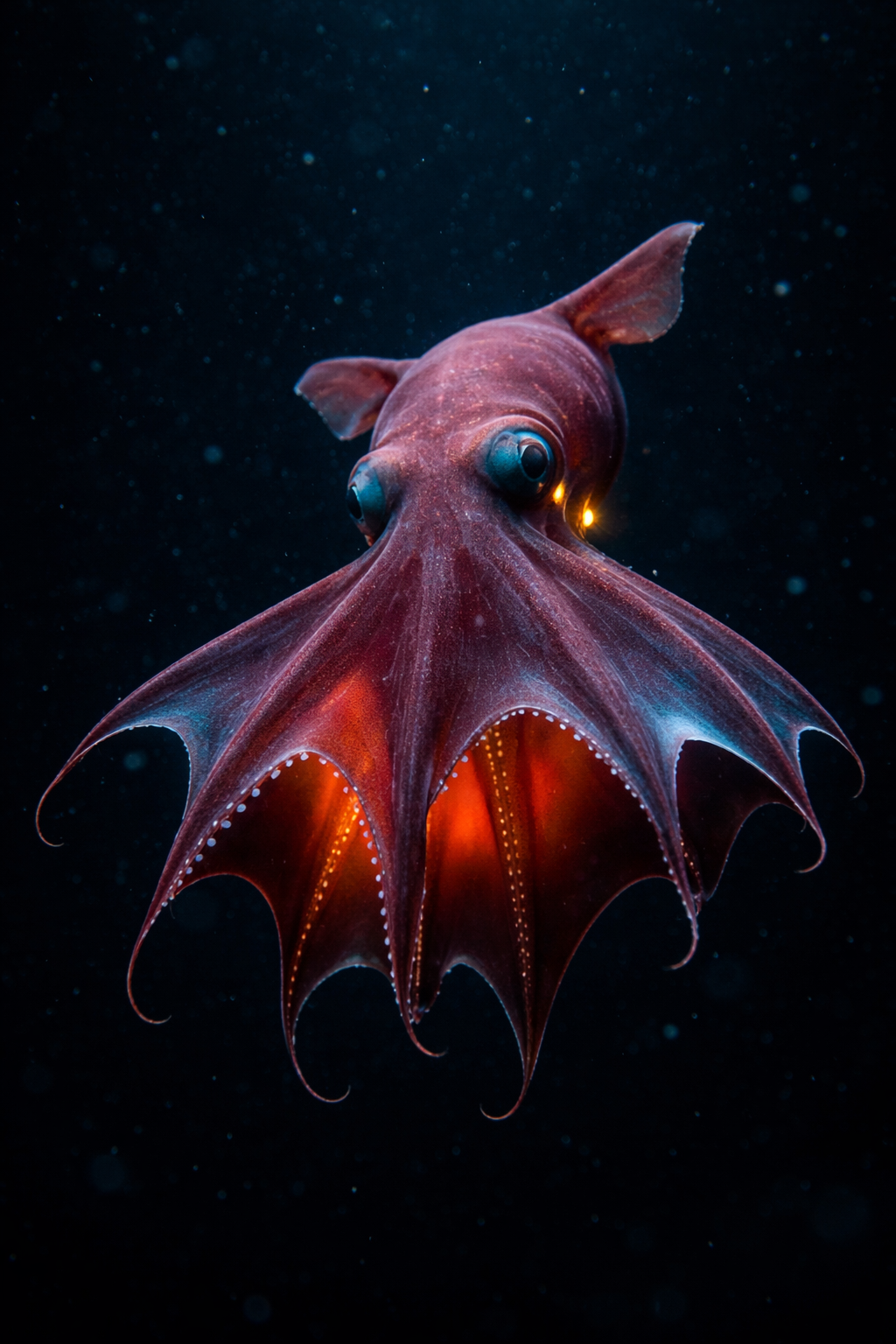
Basic Information
Scientific Name: Vampyroteuthis infernalis
Common Name: Vampire Squid
Habitat: Deep ocean waters
Depth Range: 600–900 meters
Size: About 15–30 cm
Lifespan: Unknown (estimated several years)
How Vampire Squid Live.
The vampire squid lives in the oxygen minimum zone of the ocean—areas where oxygen levels are extremely low. Most animals cannot survive here, which gives the vampire squid a safe habitat with fewer predators.
These zones are found in:
Tropical oceans
Temperate deep waters
Physical Appearance
The vampire squid looks like something from science fiction:
Dark red or black body
Large blue eyes (some of the largest eyes relative to body size in the animal kingdom)
Webbed arms that form a cloak-like shape
Soft, gelatinous body (not built for speed)
Its color helps it blend into the darkness of the deep sea.
Is It Really a Squid? Interestingly, the vampire squid is not a true squid or octopus. It belongs to its own ancient group, making it a living fossil that shares traits with both.
How they defend themself from preditors.
When threatened, the vampire squid performs a behavior called the “pineapple posture”:
It turns its arms inside out
Exposes spiky-looking projections (which are harmless)
Appears much larger and more intimidating
This scares predators without the need to fight or flee.
What vampire squid eats.
Unlike most squid, the vampire squid does not hunt live prey.
They eat.
Marine snow (dead plankton, algae, waste particles)
Tiny drifting organic matter
It uses sticky mucus and fine filaments to collect food floating in the water.
👉 Because of this, it is sometimes called a deep-sea scavenger.
How Does It Survive Low Oxygen?
The vampire squid has incredible adaptations:
Very slow metabolism
Special blood that binds oxygen efficiently
Large gills relative to body size
These features allow it to survive where most predators cannot.
Bioluminescence (the biochemical emission of light by living organisms such as fireflies and deep-sea fishes.)
The vampire squid can produce light using special organs:
Emits blue light (travels best underwater)
Used to confuse predators
Can release glowing mucus to distract attackers
Unlike anglerfish, it does not use light to hunt.
3. Giant Isopod
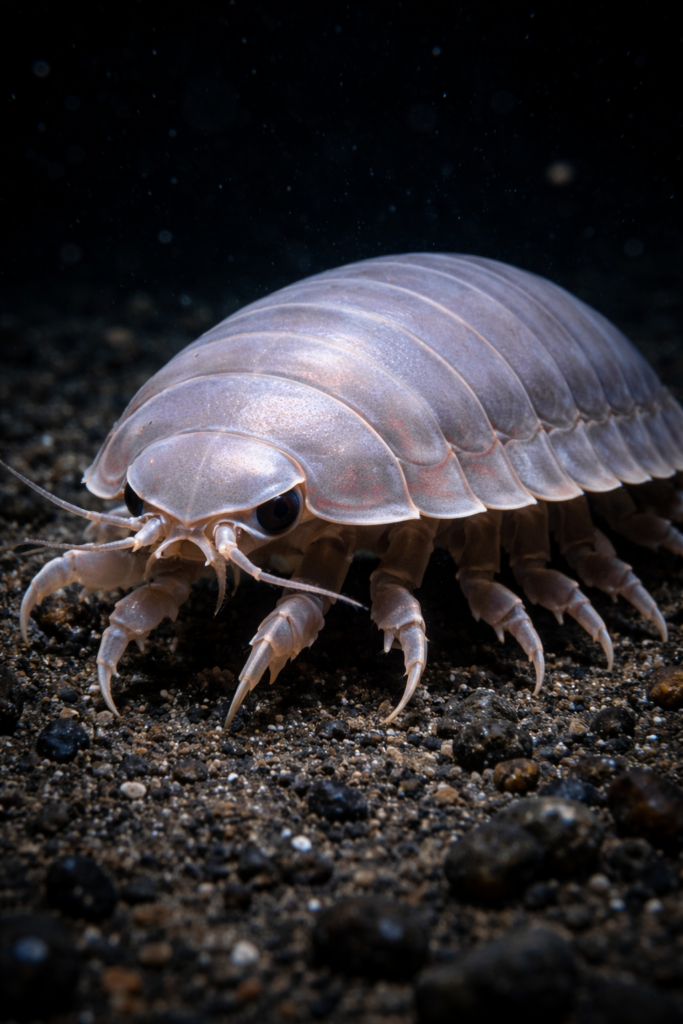
Meaning of Isopod.
Isopods are a diverse order of over 10,000 species of crustaceans—related to crabs and shrimp—found in marine, freshwater, and terrestrial habitats worldwide. Known for having rigid, segmented exoskeletons, seven pairs of legs, and two pairs of antennae, they range from tiny backyard pill bugs (roly-polies) to massive deep-sea giants.
The Deep Sea’s Armored Scavenger
The giant isopod is one of the most fascinating creatures of the deep sea. Often described as an oversized pill bug, this ancient crustacean has survived for millions of years in the dark, cold depths of the ocean.
Depth: 170–2,000 meters
This creature looks like an oversized pill bug and can grow up to 50 cm long.
Info
Common Name: Giant Isopod
Scientific Name: Bathynomus giganteus (most well-known species)
Family: Cirolanidae
Type: Crustacean
Habitat: Deep ocean floor
Depth Range: 170–2,140 meters
Giant isopods are found on the deep-sea floor of:
The Atlantic Ocean
The Pacific Ocean
The Indian Ocean
They prefer cold, dark environments where food is scarce.
There appearance
Length: Up to 50 cm (some species larger)
Weight: Up to 1.7 kg
Body Shape: Flattened and segmented
Color: Pale gray or purple
Shell: Hard, armor-like exoskeleton
Their tough shell protects them from predators and pressure.
How they become this large.?
This phenomenon is known as deep-sea gigantism. In cold, high-pressure environments:
Metabolism slows down
Bodies grow larger
Energy is used efficiently
This helps giant isopods survive long periods without food.
4. Goblin shark
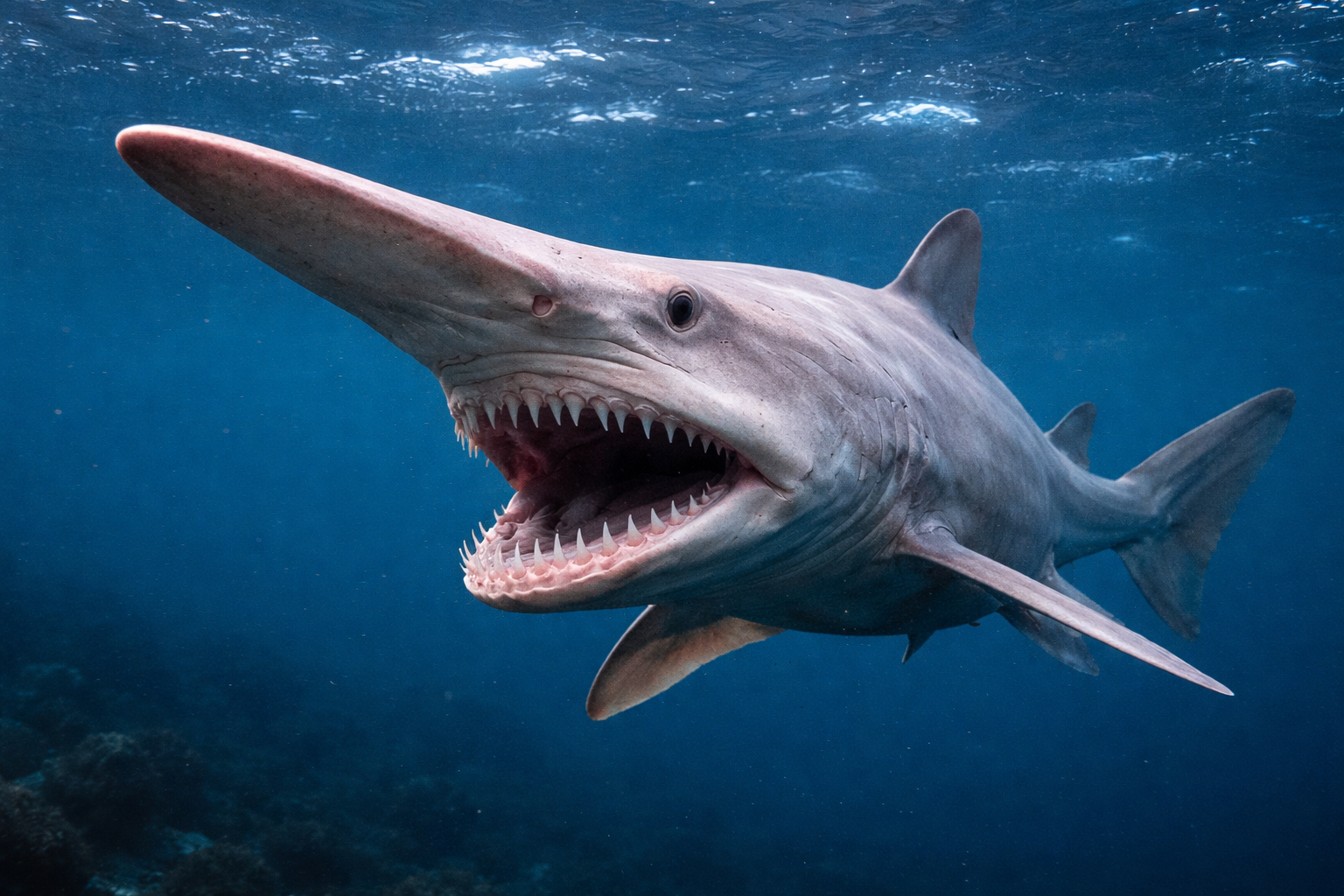
The goblin shark (Mitsukurina owstoni) is one of the ocean’s most unusual and mysterious predators. With a long, flattened snout and highly extendable jaws, this deep-sea shark uses electric sensors on its rostrum to hunt prey in the dark abyss. Though rarely seen by humans, its unique anatomy has made it a favorite topic among marine biologists and ocean enthusiasts alike.
**“The goblin shark (Mitsukurina owstoni) is a rare deep-sea shark found in oceans worldwide. It’s the only living member of its family, Mitsukurinidae — earning it the nickname ‘living fossil.’”
How they look like
Goblin sharks have a distinctive elongated, flattened snout and soft, flabby bodies with a pinkish-gray hue. Their most remarkable feature is their highly protrusible jaws — they can shoot their jaws forward quickly to snatch prey with rows of long, needle-like teeth. The snout is thought to be covered with sensory organs that help the shark detect faint electrical signals from other animals in the dark ocean depths.
Their Habitate
These sharks inhabit deep-water environments, usually near the bottom on continental slopes and seamounts. They have been found in parts of the Atlantic, Pacific, and Indian Oceans at depths ranging from a few hundred meters down to over a thousand meters. Sightings and captures are rare, making them one of the least observed shark species.
How they hunt
Goblin sharks are not strong swimmers and are thought to move slowly through the water. They use their long snout’s sensory organs to locate prey such as fish, squid, and crustaceans. When prey is close, they rapidly thrust their jaws forward to catch it — an adaptation that helps them feed effectively in the dimly lit deep sea.
5. Dumbo Octopus
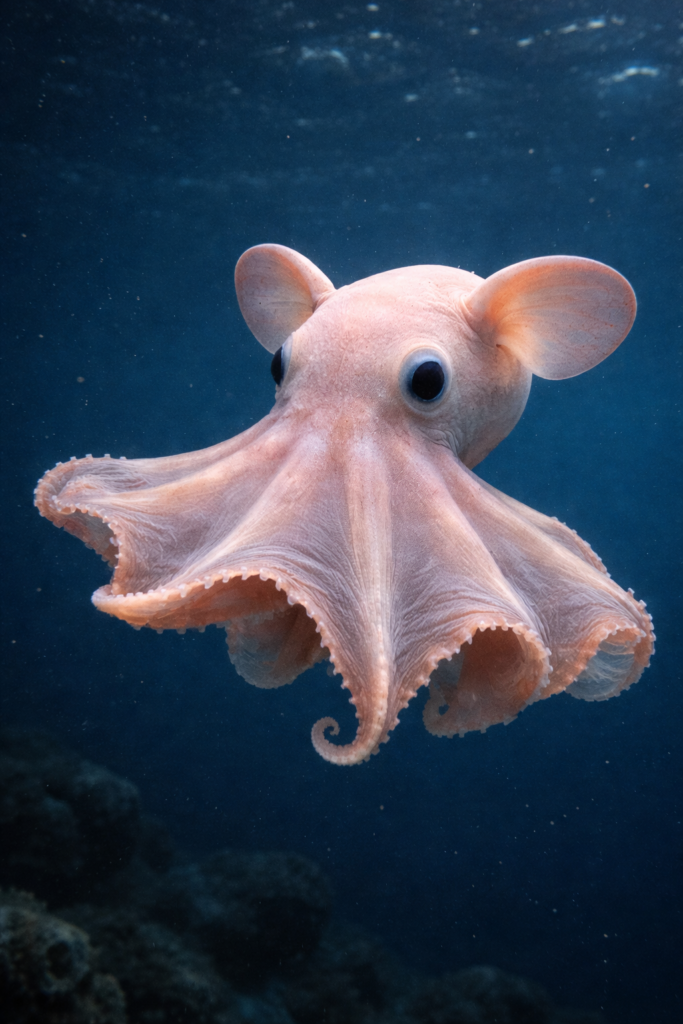
The Dumbo octopus refers to a group of deep-sea octopuses in the genus Grimpoteuthis. They are named “Dumbo” because of the large, ear-like fins on either side of their heads that resemble the ears of the famous elephant character.
They Live in:
Dumbo octopuses inhabit the deep open ocean around the world — from the Atlantic and Pacific to other major oceans. They are among the deepest-living octopus species, commonly found between about 1,000 and 4,000 meters (3,300–13,100 feet) below the surface, with some sightings even deeper.
These depths are far beyond where light can reach, meaning these animals live in cold, dark, and high-pressure environments.
Their Appearence
Dumbo octopuses usually have semi-translucent, soft bodies with a bell-shaped mantle and webbed arms. The ear-like fins above their almost blind eyes are their most striking feature.
Most species are fairly small, averaging about 20–30 cm (8–12 inches) in length, though some individuals can grow larger.
They Eat
These octopuses are foraging predators, meaning they search for food that drifts or lives near the seafloor. Their diet includes small invertebrates such as crustaceans, worms, and bivalves.
They tend to swallow prey whole rather than tear it apart, which is different from many shallow-water octopus species.
Behavior & adaptions
Movement: Instead of rapid jet propulsion, they use fin flapping and arm motion to glide or swim.
No ink sac: Because predation is rarer at such depths, Dumbo octopuses do not have an ink sac like many shallow-water octopuses.
Reproduction: Females may carry eggs in different development stages at the same time, allowing them to lay eggs nearly any time they meet a mate.
6. Barreleye Fish
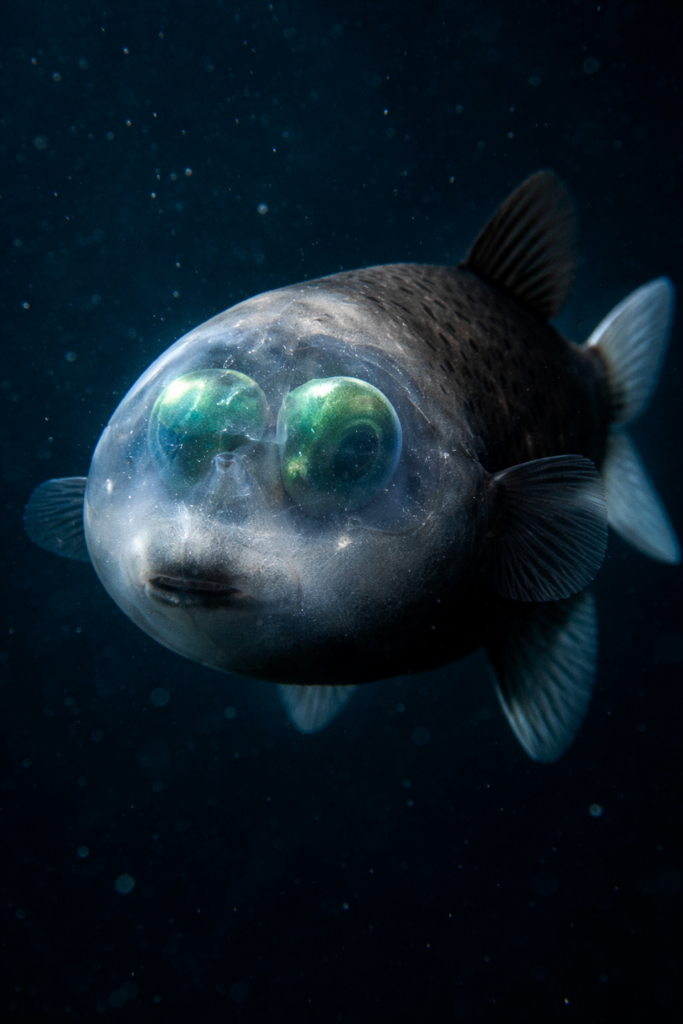
- Its also called Macropinna microstoma
- It lives around 600–800 meters
It seems unreal because of his appearance, but its real,
- The barreleye fish is famous for its transparent head. Yes — its skull is see-through. Inside are tubular eyes that can rotate upward or forward, allowing it to spot prey above while avoiding predators.
- This unusual adaptation helps the barreleye detect faint silhouettes of jellyfish and other drifting organisms. It often steals food from the tentacles of jellyfish, carefully maneuvering to avoid being stung.
- For years, scientists believed its eyes were fixed in place. It wasn’t until live observations that researchers discovered the eyes could move, revealing just how advanced and specialized this deep-sea fish really is
7. Black Dragonfish
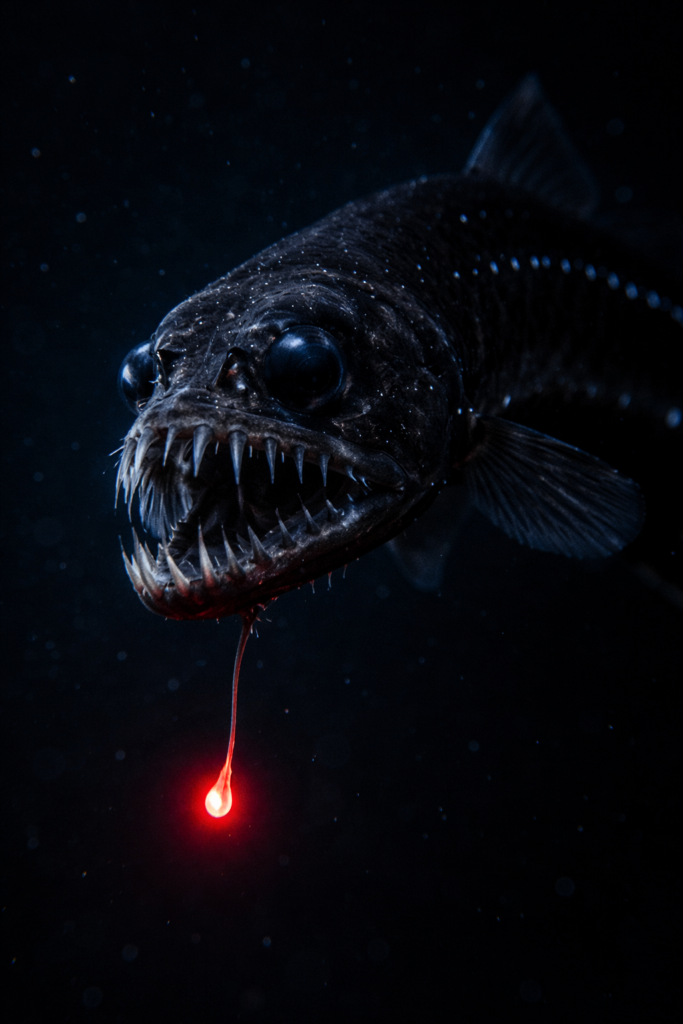
Its also called Idiacanthus atlanticus
Its live around 500–2,000 meters
- Its look like Angler fish. but its Black dragonfish belong to the dragonfish family (Stomiidae).
- Anglerfish belong to the anglerfish group (Lophiiformes).
They are not closely related.
- The black dragonfish is a master of stealth in the deep ocean. Its jet-black body absorbs nearly all light, making it almost invisible. Hanging from its chin is a glowing barbel that produces light to lure prey closer.
- Unlike most deep-sea fish, the black dragonfish can produce red bioluminescent light. Since most deep-sea creatures cannot see red light, this allows the dragonfish to “see” prey without being seen itself.
Its long, needle-like teeth are too large to fit inside its mouth, giving it a fearsome look. Despite this, it’s a precise hunter that targets smaller fish drifting in the darkness.
8. Yeti Crab
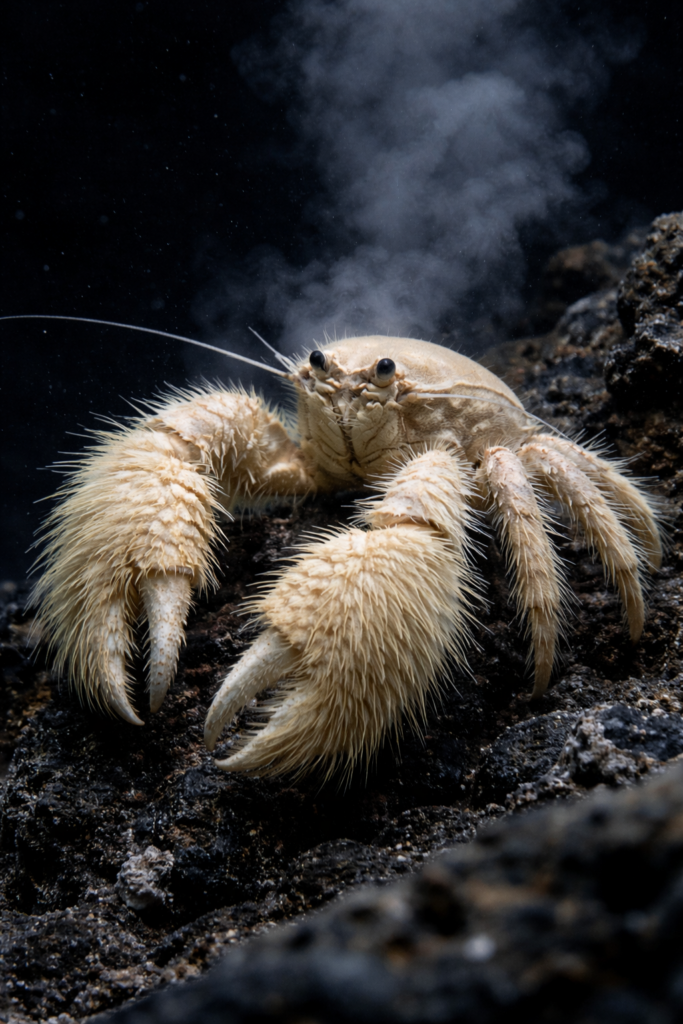
- Scientific name: Kiwa hirsuta
Depth range: 2,200 meters Common name: Yeti crab
Scientific name: Kiwa hirsuta
Habitat: Deep ocean near hydrothermal vents
Depth range: Around 2,000 meters below sea level
Discovery: First discovered in 2005
Appearance: Pale white body with long, hairy claws
Special feature: Hair-like filaments on claws that grow bacteria
Diet: Feeds on bacteria grown on its own claws
Vision: Very small eyes; limited eyesight
Behavior: Waves claws through vent water to help bacteria grow
Environment: Lives in complete darkness with toxic chemicals
Survival strategy: Relies on bacteria instead of hunting prey
- The fine hairs covering its claws are home to colonies of bacteria
- These bacteria feed on chemicals released by the vents and help break down toxic substances. The crab waves its arms through the water to help the bacteria grow, forming a unique relationship that benefits both organisms.
- Instead of actively hunting prey, the Yeti crab feeds by harvesting the bacteria growing on its own claws.
This makes it one of the few animals known to “farm” its food in such an extreme environment. Its small eyes suggest vision isn’t important where it lives, and most of its behavior is guided by touch and chemical signals rather than sight.
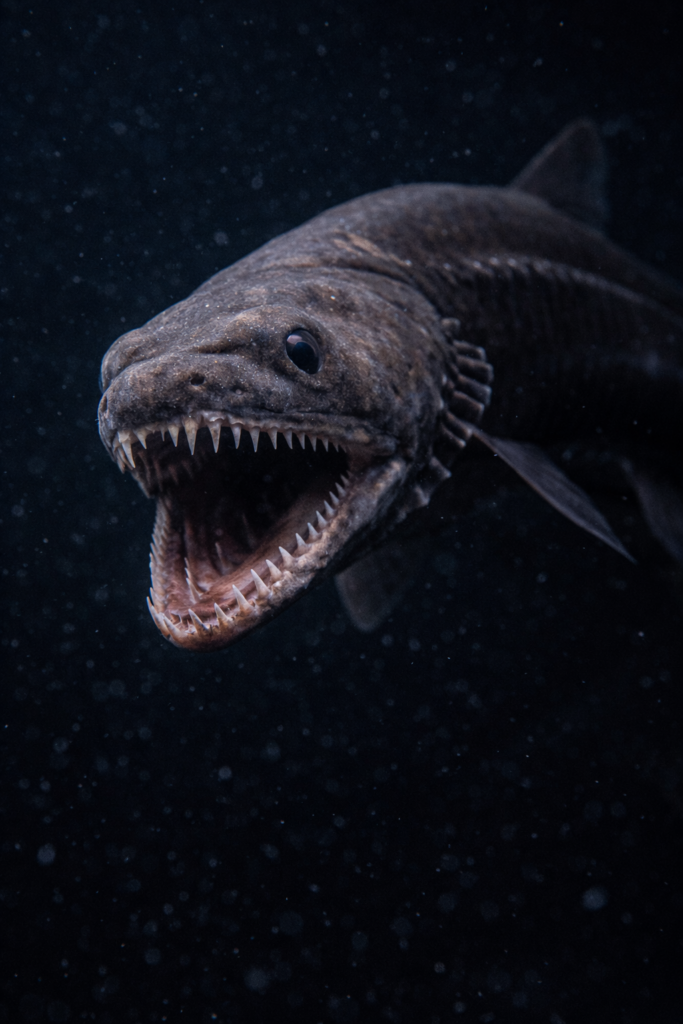
9. Frilled Shark
Lorem ipsum dolor sit amet, consectetur adipiscing elit. Ut elit tellus, luctus nec ullamcorper mattis, pulvinar dapibus leo.
Lorem ipsum dolor sit amet, consectetur adipiscing elit. Ut elit tellus, luctus nec ullamcorper mattis, pulvinar dapibus leo.
Lorem ipsum dolor sit amet, consectetur adipiscing elit. Ut elit tellus, luctus nec ullamcorper mattis, pulvinar dapibus leo.
ugerhgtwvtrtthjfr